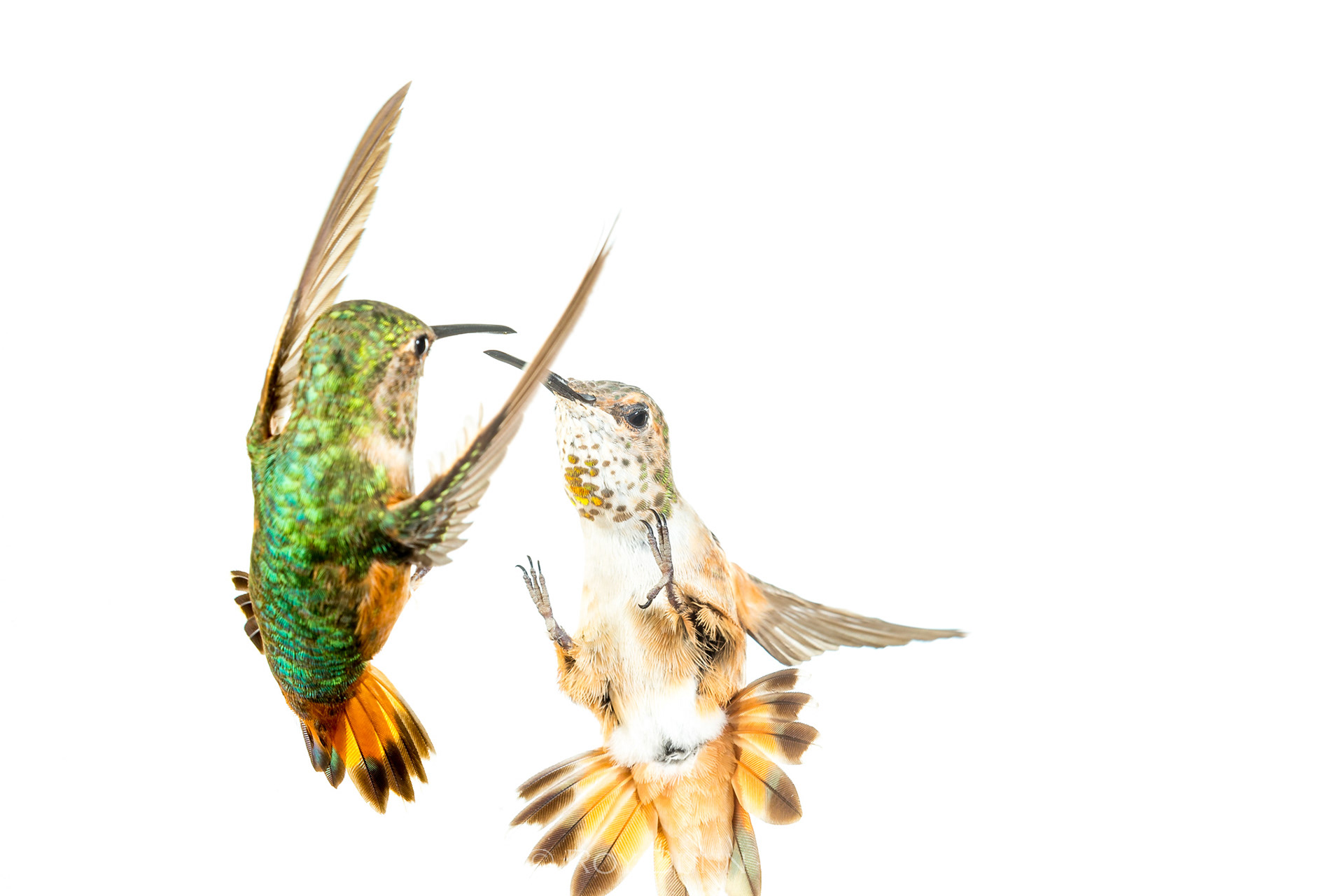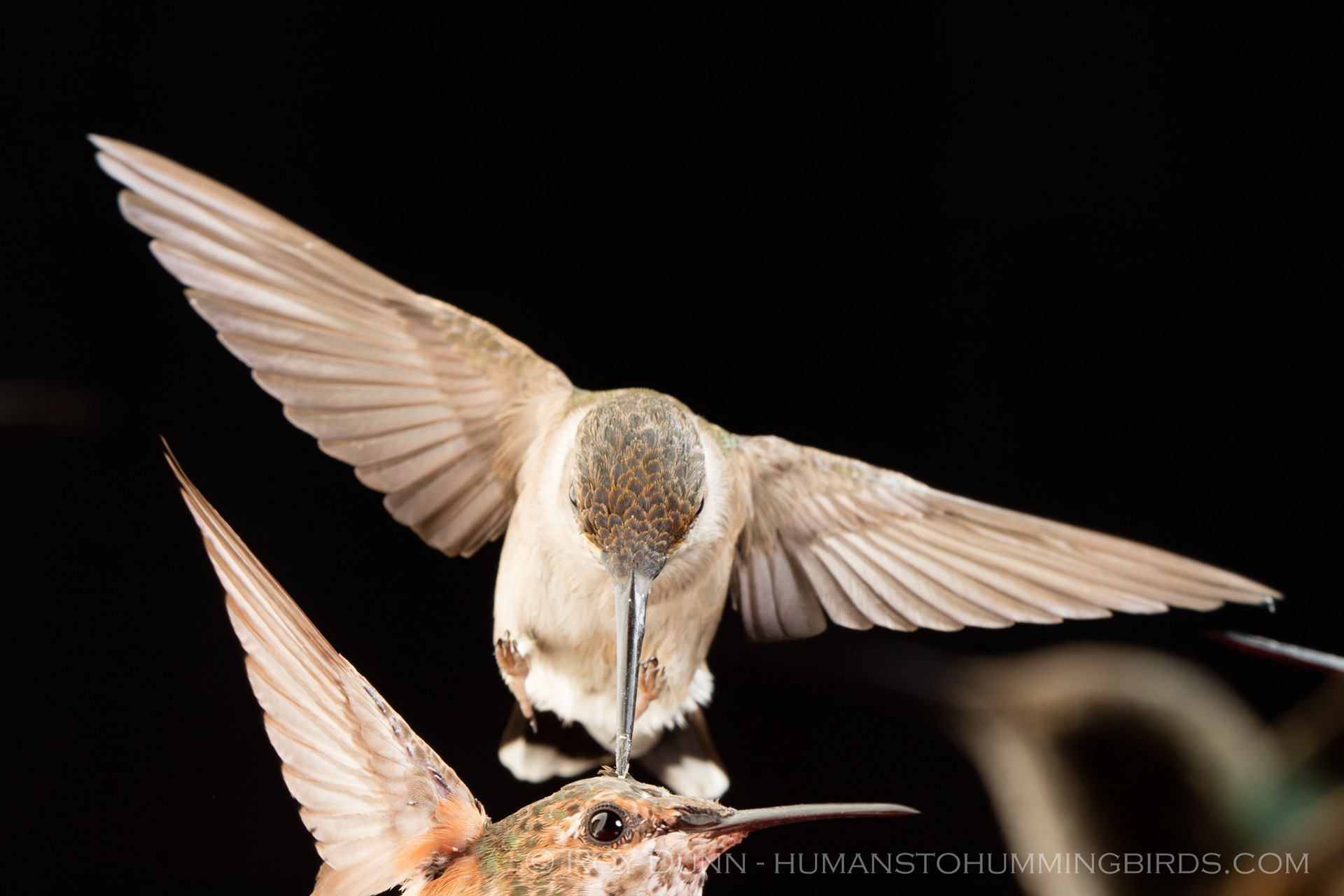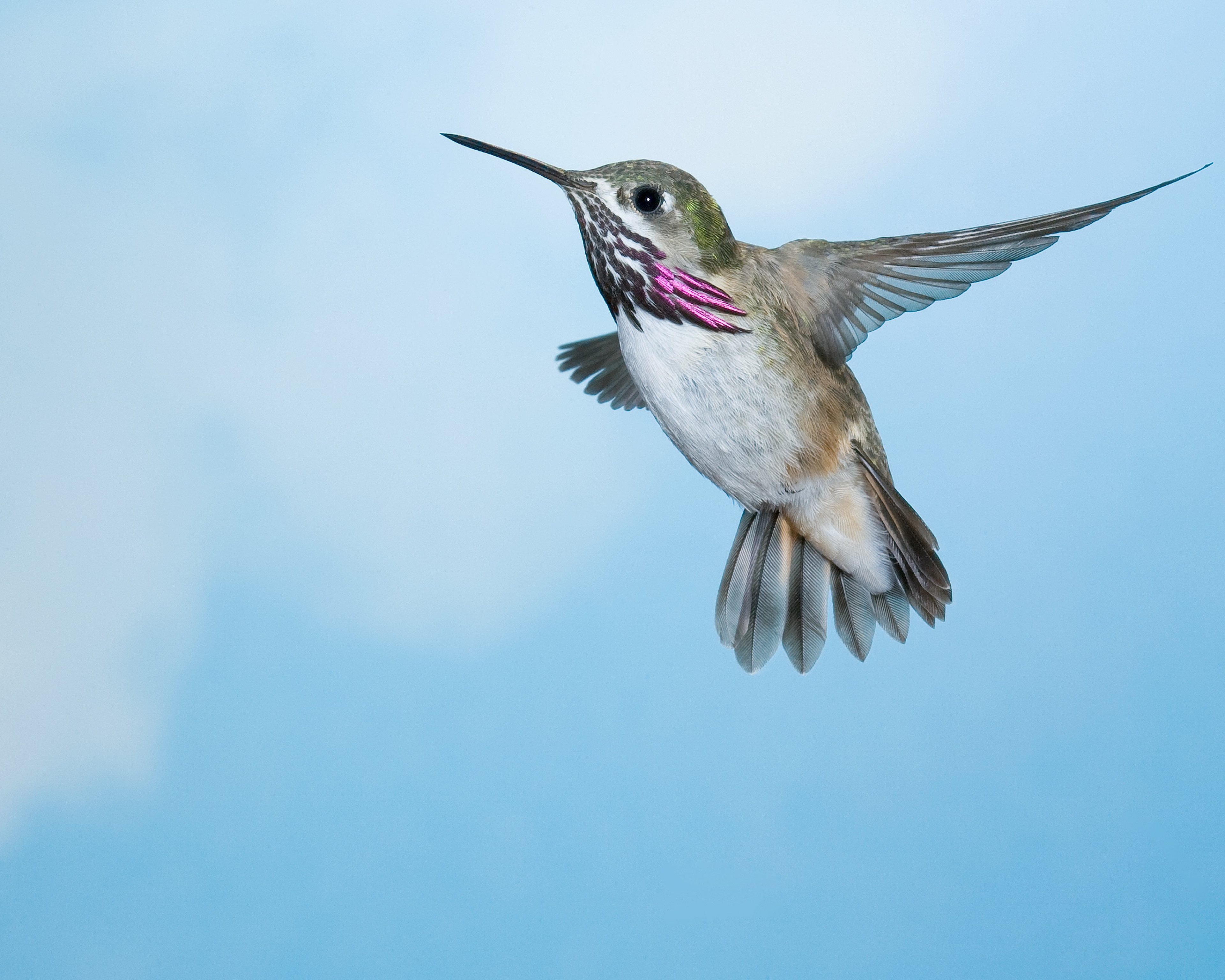
I began photographing hummingbirds in 1996, just a few days after moving to the US from England (though I am originally Australian—a long story for another time). Over the course of fifteen years, I captured well over 750,000 images, fewer than a hundred of which feature a perched bird. I deliberately choose the difficult path: capturing them in mid-flight, utilizing high-speed flash, and ideally, interacting. What is important to note is that all images were shot with manual focus. No autofocus could keep up back then. It was down to me. The hit-rate for capturing multiple flying birds in the same frame—perfectly in focus and with an acceptable composition—is roughly 1 in 12,000.
Most sane people would call that dogged insanity. I call it perseverance. One might assume the process becomes boring or frustrating; the latter is certainly true, but the former, never. I remain entirely entranced every single time I sit down to photograph these fabulous jewels of the sky.
Don't be fooled by their appearance, though. As beautiful, iridescent, tiny, and exquisite as they are, hummingbirds are plain mean. Ferocious, even. Turf wars abound—males versus males, females versus females, and males versus females. It is astonishing to witness the lengths to which these tiny bullies will go to ensure another hummer isn't trespassing on their territory.
All of my hummingbird images—and all of my wildlife photography, for that matter—feature wild, free, and unmanipulated animals. The only digital processing I perform is adjusting color balance and contrast, and removing dust specks. If you see an image with multiple birds in the frame, they were captured together in-situ.
When people view my work on a wall or at the Vault Gallery in Cambria, California, they occasionally assume the images are either paintings or the product of heavy digital manipulation, declaring, "You can't get a pure white or pure black background in-camera." Au contraire. Black is simply the absence of light and is relatively straightforward to achieve. The white backgrounds are actually the cream-colored stucco on the side of my house, just above a small garden. By utilizing high-powered, short-duration flash to overexpose the wall, it turns a clean, pure white. (With enough flash power, you can make a black wall appear white). Ultimately, the key element of my hummingbird photography is nearly 30 years of refined technique.
While my active mountain lion conservation work has meant my hummingbird photography has waned in recent years, I am looking forward to shooting several hundred frames a day again soon—if only to keep one or two.
Feel free to check out any of my three galleries of hummingbird imagery:
If you would like to purchase an aluminum Limited Edition Print of a selection of my hummingbird images, head on over to Artsy, where they are available exclusively through the Vault Gallery in Cambria, CA.